
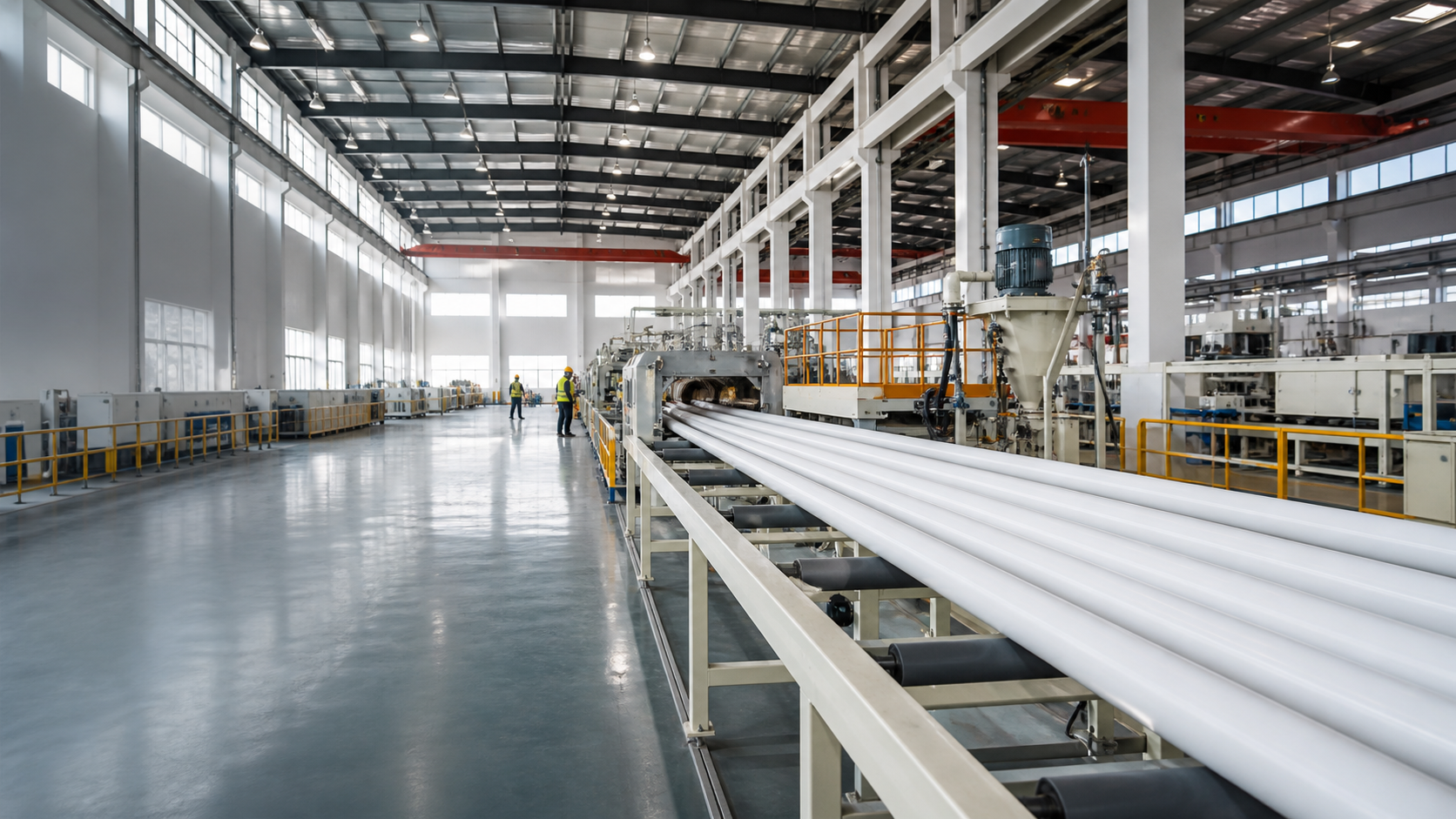
PVC conduit and drainage-pipe producers use calcium carbonate as a functional mineral filler to help manage compound cost, extrusion behavior and finished-product consistency. The right grade is not chosen by mesh number alone. Particle-size distribution, surface treatment, moisture, dispersion and the existing lubricant package all influence the result on the line.
Where calcium carbonate contributes in PVC pipe
In a PVC pipe compound, calcium carbonate can support stiffness, dimensional control and economical formulation design. It must also disperse uniformly so that the extruder receives a consistent material stream. Poorly matched powder may increase torque variation, affect surface quality or require more process adjustment.
What to review before selecting a grade
- Pipe type, wall-thickness target and loading level
- Current resin, stabilizer, ACR, wax and stearic-acid system
- Extrusion temperature, output and surface-finish requirement
- Moisture, fineness and dispersion requirements for the production line
Why modified grades matter
HeBei Shoushi supplies modified ground calcium carbonate from 600 to 5000 mesh. Application-oriented treatment is designed to improve compatibility and provide a lower oil-absorption direction than comparable untreated powder. In practice, this can help the formulator review whether the lubricant and processing-aid package can be optimized. Results depend on the complete formulation and require customer-side validation.
A practical project approach
We begin with the current formulation and process conditions, then discuss an appropriate powder grade, surface-treatment direction and trial plan. For PVC pipe customers, the aim is not simply to add more filler. The aim is to obtain repeatable extrusion and a cost/performance balance that meets the intended standard.
Need a grade review? Visit our Products & Solutions page or request a quote with your application, current specification and monthly volume.